
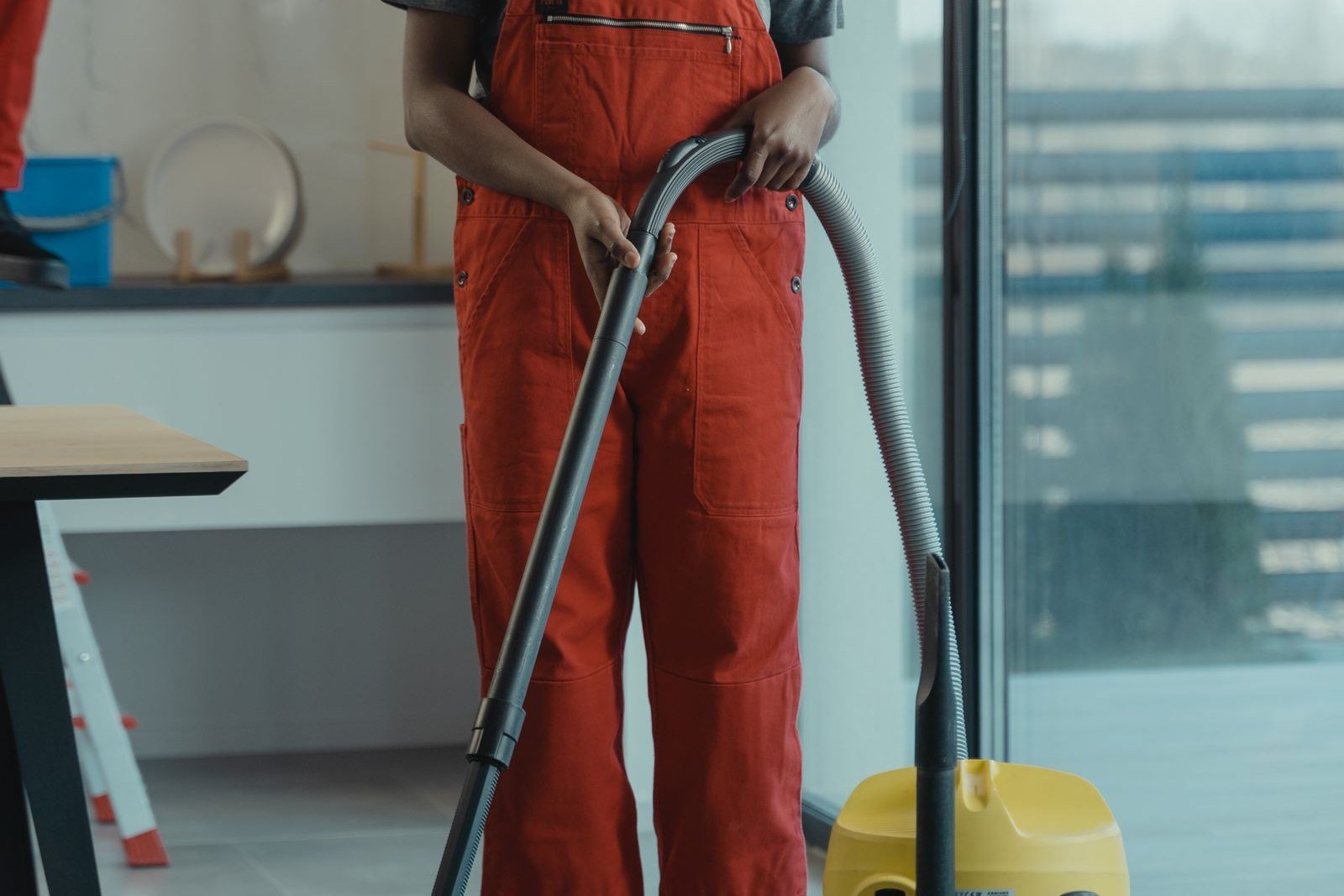
Every home has two kinds of dirt. There is the visible weekly layer, dust on shelves, crumbs on worktops, toothpaste in the sink, floors that need a vacuum, and then there is the slow layer underneath, the limescale creeping up the shower screen, the grease film on top of the kitchen cupboards, the grey line along the skirting, the dust inside the extractor vents. Regular cleaning deals with the first layer. The second layer is what deep cleaning exists for, and no amount of weekly wiping ever touches it.
Confusion between the two is the most common reason people feel disappointed with cleaning, whether their own or a professional’s. They book a standard clean expecting the oven to come back to showroom condition, or they scrub every weekend and cannot understand why the bathroom still looks tired. The two jobs are different in scope, method, time and purpose, and once you understand the difference, deciding what your home needs becomes straightforward. This guide draws the line clearly and gives you an honest way to choose.
What Regular Cleaning Actually Covers
Regular cleaning is maintenance. Its job is to stop a lived-in home sliding backwards, and done consistently it keeps a house pleasant, hygienic and presentable indefinitely. A typical weekly or fortnightly visit covers the surfaces a household touches and sees every day.
- Kitchens, worktops, sink, hob top, cupboard fronts and appliance exteriors wiped, floor vacuumed and mopped
- Bathrooms, toilet, basin, bath and shower cleaned, mirrors polished, floor done
- Living areas and bedrooms, dusting of accessible surfaces, furniture tidied, floors vacuumed
- Bins emptied, touch points wiped, general tidying to an agreed level
The defining word is accessible. Regular cleaning works on what can be reached in the time available without moving furniture or dismantling anything, and its power is frequency. Little and often beats rare and heroic for keeping a home liveable, which is exactly what a regular cleaning service is built to deliver week after week. The other quiet advantage of a fixed routine is that problems get spotted early, a new damp patch, a leak under the sink, a stain while it is still removable, because the same surfaces are being looked at closely on a schedule rather than glanced at in passing.
What Deep Cleaning Actually Covers
Deep cleaning is a reset. It targets the accumulated layer that regular cleaning maintains around but never removes, and it works room by room at a completely different intensity. In a kitchen that means inside the oven, fridge, freezer and microwave, inside cupboards and drawers, on top of the wall units, behind and beneath appliances where years of crumbs and grease live, full descaling of the sink and taps, and degreasing of the extractor and its filters. In a bathroom it means limescale stripped from screens, tiles and fittings rather than wiped over, grout cleaned back to colour, the extractor fan cover, the pedestal backs, the floor edges behind the toilet. Through the rest of the house it means skirting boards, door frames and the tops of doors, light fittings, switch surrounds, window frames, sills and internal glass, radiators including behind them, under and behind furniture, and vents and high corners where dust webs form.
A proper deep clean of an average family home is a full day or more for a team, which is the honest reason it cannot be an every-week event and why it is priced differently from maintenance visits. It is a different job, done with different equipment and different chemistry, and the results last accordingly, since a room stripped back to genuinely clean surfaces takes months to reaccumulate what a wipe-over never removed in the first place.
The Health Dimension Most People Miss
The deep layer is not just cosmetic. House dust is largely skin cells, fibres and the waste of the dust mites that feed on them, and mite allergen is one of the most significant indoor triggers for asthma, eczema and rhinitis. Charities such as Allergy UK publish extensive guidance on managing indoor allergens precisely because the home environment moves symptoms in a way medication alone cannot. The places that hold allergen load, carpet pile, mattresses, upholstery, bedding, high dust reservoirs, are almost all deep-cleaning territory rather than weekly-wipe territory.
For households with allergy or asthma sufferers, that changes the calculation. Periodic deep cleaning, along with extraction cleaning of carpets and attention to mattresses, is part of managing the condition, not a luxury. Damp-prone rooms carry a parallel story with mould, where the fix is treating the affected surfaces properly and then keeping moisture down, and a deep clean is usually the moment that reset happens.
How Often Does a Home Need Each
There is no universal schedule, but the patterns are consistent enough to plan around. Regular cleaning suits most working households weekly or fortnightly, tightening with children, pets or busy shared spaces. Deep cleaning earns its keep on a cycle, and the sensible baseline for a maintained home is once or twice a year, with the following situations pulling it forward.
- Moving house, where a move in clean resets a property to your standard before your furniture hides the evidence of the last occupants
- Before or after major life events, a new baby, an elderly relative moving in, recovery from illness in the house
- After building work or decorating, since plaster and sanding dust reaches places ordinary dust never does
- Seasonal resets, the traditional spring clean, or pre-winter when the house is about to be sealed up with everyone inside
- When regular cleaning has lapsed for months, because restarting maintenance on top of accumulation maintains the accumulation
That last point is the key relationship between the two services. Regular cleaning holds whatever standard it starts from. Start it after a deep clean and it holds a high standard. Start it on a tired house and it faithfully preserves the tiredness.
An Honest Self Assessment
If you are unsure which your home needs, walk it with a stranger’s eyes and ask a few blunt questions. Does the shower screen look cloudy even after it is cleaned? Does the kitchen smell faintly of old grease when you come back from a week away? Are the skirting boards grey? Would you be comfortable opening your oven in front of a guest? Does dusting seem to need doing again within a day or two, a classic sign of loaded carpets and soft furnishings recirculating dust? Do allergy symptoms ease when you leave the house?
Mostly no, and your maintenance routine is working, keep it running. Two or more yes answers, and the house is carrying an accumulated layer that maintenance will never clear, and the deep clean should come first, with regular cleaning holding the result afterwards. If the answers split by room, one tired bathroom in an otherwise maintained house, a targeted single-room deep clean is a perfectly sensible middle path. That sequence, reset then maintain, is the single most cost-effective way to run a home, because every maintenance visit afterwards works on a clean baseline instead of fighting history.
Doing It Yourself Versus Bringing In a Team
Everything in a deep clean is technically possible for a determined householder, and the honest limits are time, equipment and chemistry. The time cost of a genuine whole-house deep clean is a full weekend or more of hard physical work, and the tasks people defer, the oven, the limescale, the carpets, are deferred precisely because they are the hardest. Equipment matters at the extremes, extraction machines for carpets and upholstery outperform anything hireable, and professional-grade descalers and degreasers, used with trained care, achieve in minutes what supermarket products approach in hours. There is no shame in a hybrid, plenty of households handle their own weekly maintenance and bring in a team once or twice a year for the reset, or book a one-off clean before a big occasion. The failure mode to avoid is the permanent deferral, where the deep layer compounds quietly for years and the eventual recovery is a bigger job than a schedule would ever have been. Landlords and busy professionals feel this hardest, because the properties and weeks with the least spare attention are exactly the ones where the layer builds fastest.
Reset First, Then Maintain
Deep cleaning and regular cleaning are not competitors, they are a sequence. The deep clean clears the accumulated layer, resets the health baseline and makes every surface maintainable again. Regular cleaning then holds that standard at a fraction of the effort, indefinitely. Homes that run both on a sensible cycle simply never develop the tired, uphill feeling that comes from maintenance fighting accumulation, and the difference is obvious the moment you walk in.
We provide both across Greater Manchester, one-off deep cleans that reset a home properly and regular residential cleaning that keeps it there. If your house has been quietly asking for a reset, tell us its size, how many bathrooms it has and what bothers you most, and request a free quote today, with weekend and evening slots available across the city.