
Most cleaning does not touch asbestos, but some does
Greater Manchester has plenty of older industrial and commercial buildings, from former mills to warehouses and offices built in the sixties and seventies. Some of them contain asbestos, and an asbestos cleaning contractor needs to know where before any work beyond a routine clean begins.
The Health and Safety Executive is clear that the risk depends on the condition of the material. Left alone and in good condition, the risk from asbestos is low. The danger starts when it is disturbed or damaged and the fibres are released into the air. You cannot see, smell or feel them.
This guide is for the manager or owner of an older commercial building who books cleaning. It explains which cleaning tasks can disturb asbestos, what the HSE says about where it is found, what a building owner must already have on file and what a cleaning team should do if they find something.
Why this is taken so seriously
The HSE says exposure to asbestos is the greatest cause of work-related deaths in Great Britain. Around 5,000 people die every year from asbestos-related diseases. These illnesses typically take decades to develop and cannot be cured.
That is why the guidance is firm. The HSE also says workers are more at risk in buildings that were built or refurbished before the year 2000. A lot of commercial buildings in the region fall into that group. The point is not to alarm anyone. It is to make sure that a cleaning visit never turns into the event that disturbs something that had been safe for decades.
Where asbestos is found in an older building
The HSE publishes guidance on the locations of asbestos and the right action to take. It lists the main materials and where they turn up. The ones most relevant to cleaning are set out below.
Floor tiles and adhesive
Asbestos was added to PVC and thermoplastic floor tiles, stair nosings, sheet materials and screed. The HSE says these can be found in places like corridors and kitchens, and that old asbestos floor tiles can be hidden under carpets. Some were stuck down with asbestos containing adhesive.
Textured decorative coatings
Textured coatings were used on ceilings and walls to make decorative finishes. The HSE notes they have had trade names such as Artex. They are hard, were often white and have frequently been painted over, so they are easy to mistake for ordinary plaster.
Asbestos insulating board
Insulating board was used for fire protection. The HSE lists internal partition walls, bulkheads above ceilings, fire door panels, lift shaft linings, ceiling tiles, external soffits and panelling around windows. It adds that it is difficult to tell the difference between insulating board and non-asbestos boards that look the same.
Asbestos cement
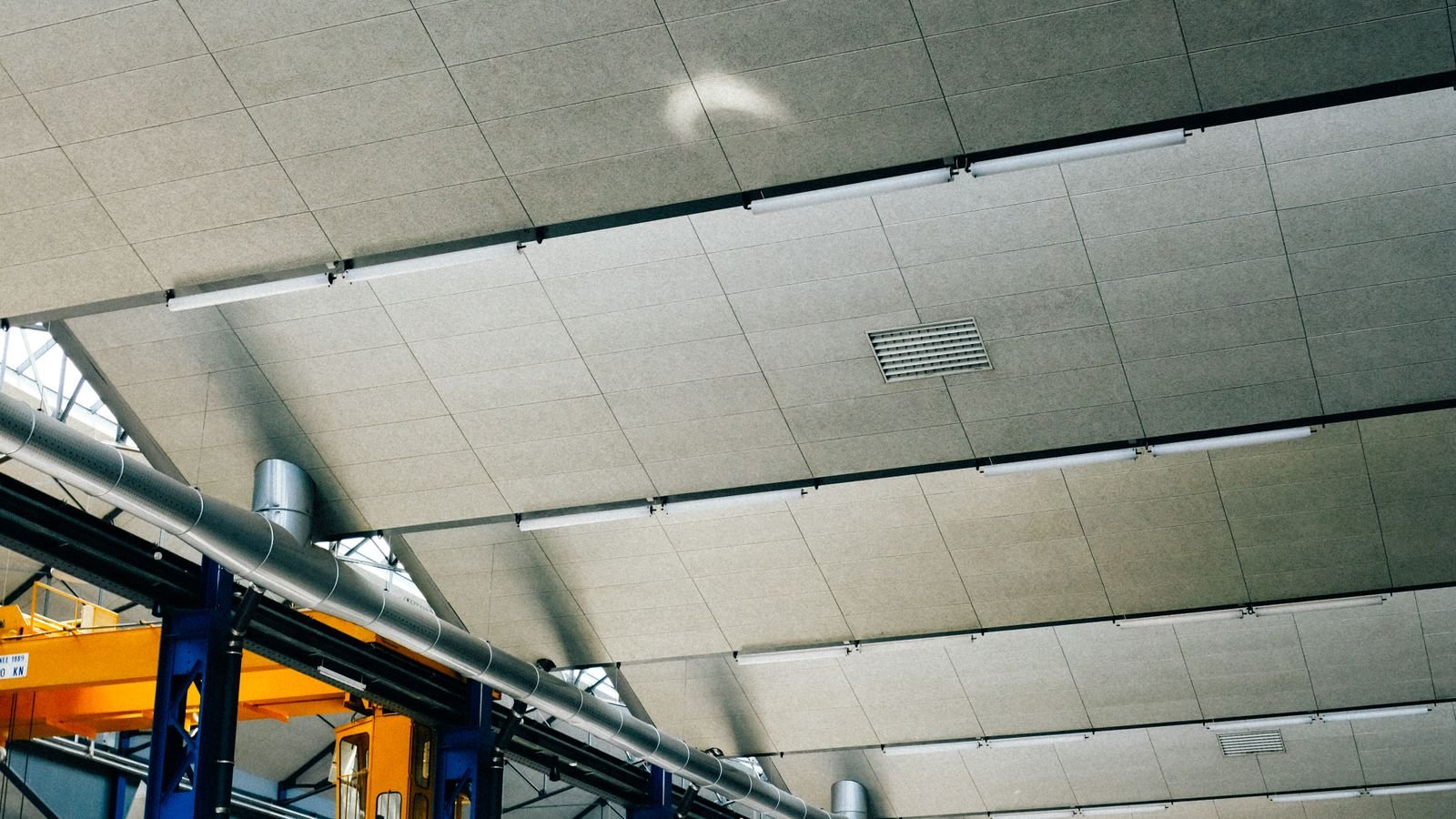
This is ordinary cement mixed with asbestos. The HSE says it is found in roofs, wall cladding, downpipes and gutters, particularly on warehouse type buildings, as well as flues and pipes. It is a hard, grey material.
Lagging and sprayed coatings
The most dangerous materials are lagging around boilers and pipework, and sprayed coatings on beams, columns and the underside of roofs. The HSE says lagging flakes and powders easily. It says sprayed coatings can contain up to 85 per cent asbestos and break up very easily, so even a minor disturbance can release large quantities of fibres. Almost all work on lagging, and all work on sprayed coatings, must be done by an HSE licensed contractor.
Which cleaning tasks can cause a problem
Wiping a desk, vacuuming a carpet and mopping a sealed floor do not normally disturb asbestos. The risk comes from tasks that break, abrade or scatter a material. In a cleaning context these include the following.
- Scraping, sanding or aggressively scrubbing old floor tiles or adhesive.
- Lifting carpet or old floor coverings where tiles may be underneath.
- Scrubbing, scraping or steaming textured ceilings and walls.
- Pushing, drilling or removing ceiling tiles and panels to reach a void.
- Brushing or blowing debris from around boilers, pipework or roof beams.
- Pressure washing or scrubbing old cement roofing, cladding or gutters.
- Clearing debris after a ceiling collapse or a leak that has damaged old board.
Many of these belong to deep cleans, post building clean ups and one off clearances. They are less common in a weekly office visit. That is why the rules are tighter for the unusual jobs than for the routine ones.
Licensed work and why a cleaning team is not the answer
The HSE separates asbestos work into lower risk jobs, which trained workers without a licence can do, and higher risk jobs, which must go to a licensed contractor. Examples of the first group include painting undamaged insulating board, drilling a hole in asbestos cement and manually removing asbestos floor tiles. Examples of the second group include most work to remove insulating board and any work on board in poor condition.
A cleaning crew is not in either group by default. Cleaning is not a route to removing asbestos, and nobody should be asked to scrape, lift or strip a material because it is in the way of a clean. If a job needs that, it becomes a job for people with the right training, and the cleaning follows afterwards.
What the building owner should already have
The HSE explains that the duty to manage asbestos falls on the dutyholder. That is the building owner, the landlord, or the person with clear responsibility for maintenance or repair. It applies to all non-domestic premises, such as factories and shops, and to the common parts of multi-occupancy domestic buildings.
The dutyholder must do several things. They must find out whether asbestos containing materials are present, how much there is, where it is and what condition it is in. They must presume materials contain asbestos unless there is strong evidence that they do not. They must keep a record or register of the location and condition. They must write an asbestos management plan, review it every 12 months or sooner if needed, and monitor the condition of the materials.
They must also give information on the location and condition to anyone who may work on or disturb the materials. In plain terms, if you own or manage an older building, a cleaning contractor is entitled to ask to see the register, and you should be ready to show it.
What a good contractor asks first
The HSE tells workers to stop and speak to the building owner if they find a material they think may contain asbestos. It says an employer should ask to see the building’s asbestos register or survey and check there is enough information to do the work. Even where a survey exists, it may not have found every location, so workers should be aware that asbestos could still be hidden.
Apply that to a cleaning job. Before a deep clean, a builders clean or a floor strip in a building built or refurbished before 2000, a good contractor will ask the following.
- Is there an asbestos register or survey for this building, and can we see it?
- Are there any materials in the work area that are marked or presumed to contain asbestos?
- Has any work taken place recently that could have damaged them?
- Is there anything we should not touch, scrub, lift or remove?
If the answer is that nobody knows, that is information too. For anything beyond routine cleaning, it is reasonable to pause and find out first.
If a cleaner finds something
The HSE gives workers a simple instruction. If you come across a material you think may contain asbestos, stop work and speak to your employer or the building owner. If asbestos is disturbed during the work, stop immediately and follow the HSE guidance on what to do.
For a cleaning team that translates into a short routine.
- Stop work and leave the area as it is.
- Keep other people out of it.
- Tell the supervisor and the building manager straight away.
- Leave any debris where it is. Do not sweep, vacuum or wipe it up.
- Wait for competent advice before anyone works there again.
The clean up of disturbed asbestos is a job for trained people with the right equipment. A cleaner trying to be helpful with a brush is the worst outcome. It should be written into the contractor’s instructions that nobody tidies up a find.
Training for cleaners
The HSE says employers must provide asbestos awareness training if the work could disturb the fabric of a building. It adds that this training does not allow anyone to work on asbestos. Its purpose is to help people recognise the risk and know what to do.
When you choose a contractor for a building like this, ask about it. A cleaner who has had awareness training is more likely to spot an odd panel or a crumbling tile and report it instead of scrubbing it.
Where our work comes in
Our warehouse cleaning takes us into large older units, and our post renovation cleaning follows building work where materials may have been disturbed. Before either starts, we ask what is known about the building. If something looks like damaged board, lagging or old tile, we stop work and report it.
The same caution applies to floors. If a commercial carpet is to be lifted or replaced in an older building, check the register first, because old tiles can sit beneath.
Getting started
If you manage an older building and are planning a deep clean, a clear out or work after a repair, tell us the age of the building and whether you hold an asbestos register. We will plan around what it says. If you do not have one, we would rather pause and ask than guess.