
A patient forms a view of a GP surgery or dental practice before they ever meet a clinician. The waiting room chairs, the smell of the corridor, the state of the patient toilet, all of it gets read as a signal of how carefully the practice does everything else. Fairly or not, a scuffed skirting board in reception makes patients wonder about the treatment room, and no amount of clinical excellence fully undoes that first impression.
For practice managers in Manchester, cleaning also sits inside a regulatory frame that ordinary businesses never deal with. Healthcare premises are expected to demonstrate that infection prevention and control is planned, delivered and monitored, not simply hoped for. That changes what you should expect from a cleaning provider, and it rules out the casual arrangements that might be tolerable in an office. This guide covers how cleaning in primary care settings differs, what a proper regime includes and how to keep the evidence trail inspectors expect to see.
Healthcare Cleaning Is Regulated Territory
GP surgeries and dental practices in England are registered with the Care Quality Commission, and the cleanliness of premises falls squarely within what inspections examine under safety. Inspectors do not just look at whether the building appears clean on the day. They ask how cleaning is specified, who is responsible for each area, how clinical and non-clinical cleaning are separated, and what records exist to show the regime actually runs as described.
The practical consequence for a practice manager is that cleaning must be auditable. A friendly cleaner who comes in three evenings a week and does a good job is not enough if nothing is written down, because an inspection is a test of systems as much as surfaces. Any cleaning contractor working in your practice should expect to operate to a written specification, sign off completed work and support your infection control lead with the documentation they need.
Splitting Clinical From Non Clinical Cleaning
The single most important structural decision in a healthcare cleaning regime is a clear line between clinical and non-clinical responsibilities. Clinical equipment, instruments and the immediate treatment field are cleaned and decontaminated by trained practice staff under the practice’s own infection control procedures. The premises around them, floors, walls, furniture, waiting areas, offices, toilets and kitchens, are the environmental layer, and this is where a professional cleaning contractor operates.
That line needs to be documented so that nothing falls into the gap between the two. The classic failure is a surface everyone assumed was someone else’s job, the underside of a treatment couch, the legs of a dental chair, the top of a wall-mounted cabinet in a consulting room. A joint walkthrough between the practice’s infection control lead and the cleaning supervisor, recorded as a room-by-room responsibility matrix, closes those gaps before an inspector or an outbreak finds them.
What the Environmental Regime Should Cover
The environmental clean in a medical or dental setting runs on the same principles as any professional contract, but at a higher standard and with tighter discipline. The core elements look like this.
- Consulting and treatment room environments cleaned daily, floors, sinks, splashbacks, door furniture, couch frames and desks, using agreed products with correct dilution and contact time
- Waiting areas and reception cleaned daily with particular attention to chairs, arm rests, children’s play equipment and the reception counter
- Patient and staff toilets cleaned and disinfected daily, with checks during busy sessions rather than once at close
- Touch points throughout, handles, rails, switches, card terminals and check-in screens, wiped daily at minimum
- Colour-coded cloths, mops and buckets, with clinical area equipment never travelling to toilets or kitchens
- Floors maintained by type, safety flooring in clinical rooms machine cleaned periodically, and carpeted admin areas covered by scheduled carpet cleaning
- Waste handled to the practice’s segregation rules, with cleaners trained on what they may and may not touch
None of this is exotic. It is disciplined basic cleaning, done in the right order with the right materials, evidenced in writing, and delivered by people who understand why the rules exist.
Waiting Rooms Carry the Infection Load
The waiting room is the most epidemiologically interesting room in any surgery. It is where unwell people sit together, touch the same surfaces and share the same air, often for half an hour at a time. During winter pressure months, the room cycles through hundreds of symptomatic patients a week.
Cleaning cannot sterilise a waiting room, but it can materially cut the surface transfer route. That means daily cleaning of every seat surface, not a quick pass around them, attention to the toys and books if the practice still provides them, regular cleaning of self-check-in screens, and prompt response when a patient is sick or an accident happens during session hours. It also means fabric matters. Wipeable seating survives this environment, and where upholstered chairs exist they need periodic extraction cleaning through an upholstery cleaning service rather than an annual glance. Flooring at the entrance carries the same weight, because a wet Manchester morning brings every patient through the door with water and grit on their shoes, and the surgery threshold becomes both a slip risk and the first surface anyone judges.
Dental Practices Have Their Own Pressure Points
Dentistry adds aerosols to the picture. Drilling and scaling generate fine spray that settles on surfaces well beyond the immediate chair, which is why dental surgery environments need thorough attention to walls, cabinet fronts, lights and floors in a radius around the chair, working from the practice’s own decontamination guidance for the clinical zone and a rigorous environmental clean beyond it.
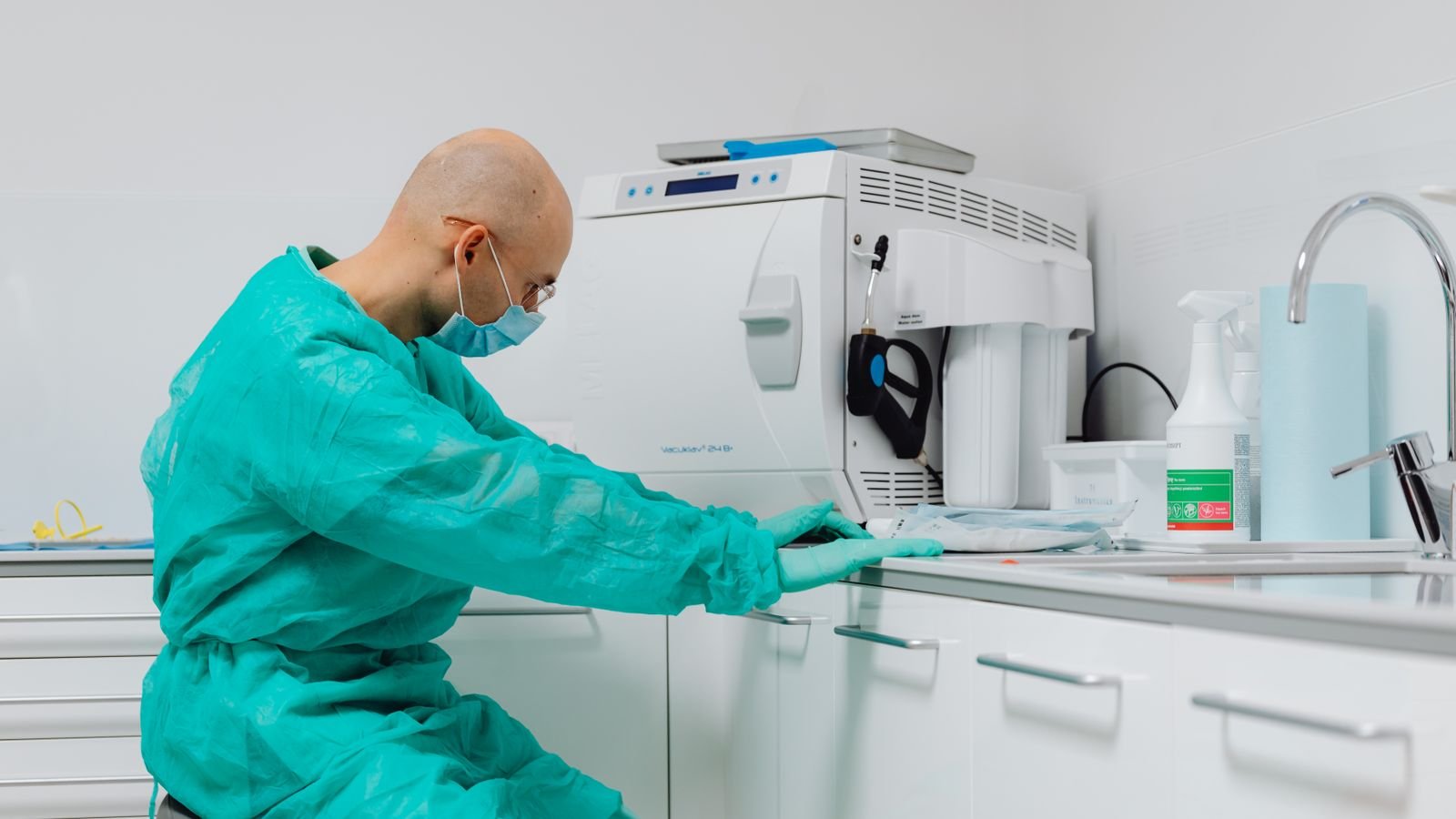
The decontamination room deserves specific mention in the responsibility matrix. Instrument reprocessing is entirely a practice-staff function, but the room housing it, floor, walls, sink exteriors and door furniture, still needs environmental cleaning to a documented standard. Waiting areas in dental practices also see anxious patients and children, which in practice means more spills, more fingerprints on glass and more wear on entrance flooring than patient numbers alone would suggest.
Records Turn Cleaning Into Evidence
The difference between cleaning that happens and cleaning that can be demonstrated is paperwork, and in a registered setting the paperwork is half the value.
- A written, room-by-room specification with frequencies, agreed between practice and contractor
- Signed daily records, so any given room’s clean on any given date can be evidenced
- A periodic audit, walked jointly by the cleaning supervisor and a practice representative, with scores or findings recorded
- Product data sheets and dilution guidance held on site
- An issues log showing that problems get raised, actioned and closed
When an inspector asks how the practice assures cleanliness, that folder is the answer. When a patient complaint arrives, it is the defence. A contractor experienced in commercial cleaning for regulated premises will treat this documentation as part of the job rather than an imposition, and that attitude is one of the quickest ways to tell healthcare-ready providers from the rest.
Timing, Access and Trust
Most practice cleaning happens after the last session, which means cleaners work unsupervised in a building containing drugs, records and expensive equipment. Vetting, insurance and reliability are not line items to skim. Ask any prospective contractor how staff are checked and inducted, how keys and alarm codes are controlled, what happens when the regular cleaner is unavailable, and who you call at seven in the morning when something is wrong. Confidentiality matters too. Cleaners will inevitably be around patient information in admin areas, and their induction should cover exactly what that requires of them.
Consistency of personnel is worth paying for in this setting. A stable team learns the building, the standards and the sensitivities, and your infection control lead builds a working relationship with a supervisor rather than starting from zero every month.
Periodic Deep Cleans Complete the Picture
Daily cleaning maintains a standard, but every practice benefits from scheduled resets, a full deep clean of the premises once or twice a year covering high-level surfaces, vents, blinds, radiators, floor machine work, descaling of washrooms and the corners daily cleaning never reaches. Many Manchester practices align these with closure days or bank holiday weekends so clinical time is untouched. The deep clean is also the natural moment to review the specification, walk the building with fresh eyes and adjust frequencies where the daily regime is falling behind. Practices that diarise these resets a year ahead never find themselves scrambling for a contractor in the week before an inspection window opens.
Patients cannot see your clinical governance, but they can see your floors. A disciplined, documented cleaning regime protects patients, supports your inspection position and tells everyone who walks in that the practice takes detail seriously. The building becomes evidence of the standard of care rather than a distraction from it.
We provide specification-led cleaning for GP surgeries, dental practices and clinics across Greater Manchester, with signed records, colour-coded methods and scheduled deep cleans built in. If your current arrangement would struggle under inspection scrutiny, request a free quote and we will walk your premises and put a proper regime in writing.