
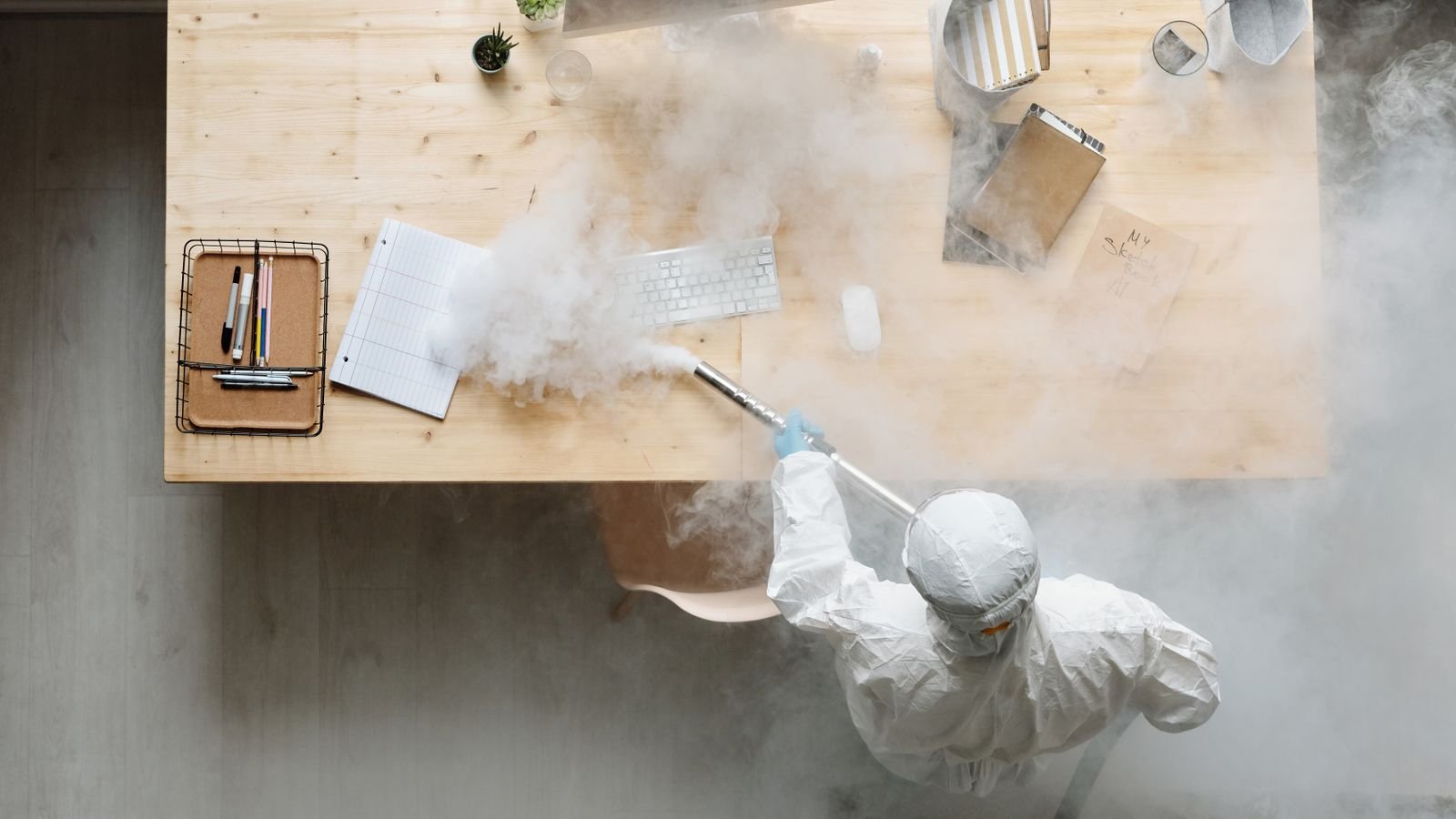
Fogging has become a familiar word in commercial cleaning. A technician arrives with a machine, fills the room with a fine mist of disinfectant, and leaves it to settle. Most businesses that book fogging expect that approach. But there is a second family of fogging, which uses hydrogen peroxide, and it works differently enough that it deserves its own explanation. Anyone searching for a hydrogen peroxide fogging service should know how it differs from the disinfectant fogging that most offices, shops and kitchens book, what it demands of the room and the people, and why none of it replaces ordinary cleaning. This guide describes the differences in general terms. It makes no promises about results, because those depend on the product, the room and how the job is carried out.
What standard disinfectant fogging is
Standard fogging uses a machine that breaks a liquid disinfectant into very small droplets and releases it into a room as a mist. The droplets travel through the air and settle on surfaces, including places that a cloth struggles to reach, such as the back of a shelf or the underside of a desk. Exclusive Pro Cleaning describes its fogging and disinfection service as delivering disinfectant as a fine mist that reaches areas manual cleaning cannot access, using approved disinfectants, and says a typical office can be fogged in a short time before the space is safe to reoccupy once surfaces have dried. That is the version most businesses book, and it is the one that fits routine hygiene protocols, reopening after illness and similar needs.
The key features of this type of fogging are practical. The disinfectant is chosen from approved products suitable for occupied commercial environments. The room is cleared of people and pets, and food and sensitive items are covered or removed. The mist is applied, the room is left to stand for the contact time on the product label, and then it is ventilated and surfaces are checked before use.
What a hydrogen peroxide fogging service is
Hydrogen peroxide is a different chemical with its own method of use. In a fogging context, a solution of hydrogen peroxide is turned into a fine fog or vapour, usually in a closed room, and left for a set period. Some systems use a dry mist, and some use a vapour process with a dedicated generator. The details vary by equipment, and manufacturers publish their own instructions.
The method is more commonly associated with controlled settings such as healthcare, laboratories and some food or pharmaceutical premises, where a sealed room and a controlled process are available. It is not a different version of the same thing so much as a separate process, with its own rules about concentration, exposure and what happens to the product afterwards, since hydrogen peroxide breaks down into water and oxygen.
This is a general description. Exclusive Pro Cleaning’s fogging page describes fogging with approved disinfectants, and does not describe hydrogen peroxide as a service. If you want hydrogen peroxide fogging specifically, ask any provider directly whether they offer it, what equipment they use and what training their staff hold. Do not assume that all fogging services use it.
How the two differ in practice
The differences show up in the preparation, the time and the people involved.
Sealing the room
A closed room matters for any fogging, but it matters more for a hydrogen peroxide process. The room usually needs to be sealed, so that vapour stays in and nobody wanders in. Doors, vents, air handling and gaps may need to be taped or closed, and ventilation systems may be switched off or isolated. In an ordinary office, that is not always easy, and in a building with shared air handling it can be impractical. A provider should walk the site first and say whether the room can be sealed.
Contact and dwell time
Every disinfectant has a contact time on its label, and fogging adds a period for the mist to settle. A vapour process can involve a longer cycle, because the system may run through a generation phase, a hold phase and then a phase for the vapour to be broken down or removed. Longer cycles mean longer closures. Plan for this in advance.
Re-entry
Re-entry means the time before people can return to the room. For any fogging, the label and the provider’s instructions set the rule. For hydrogen peroxide, re-entry is usually governed by a monitored process, where the air is checked, or by a set time, and it can be longer than for standard fogging. Never enter before the provider says it is safe. A written note of when the room was cleared for use is a sensible record.
Equipment and training
Both need trained operators, but a hydrogen peroxide process often needs specific equipment and a stricter safety procedure, with protective equipment for the operator and clear signs on the door. Ask what training the technician holds, and ask to see the risk assessment and method statement.
Materials
Different chemicals affect different materials. Some metals, rubbers, fabrics and electronics respond poorly to certain products. Ask the provider about the compatibility of their product with the contents of your room, particularly for sensitive electronics, medical equipment or antiques.
Why cleaning has to come first
This is the point that matters most, and it applies to every kind of fogging. A disinfectant works on a clean surface. Dust, grease, spills and visible dirt shield the surface and use up the product. A fogging treatment applied to a dirty room is partly wasted, and the surfaces underneath remain as they were. Professional guidance on disinfection consistently describes cleaning as the first step.
That means a fogging visit should follow a clean. Many providers will do a quick clean of touch points before fogging, but for a room that has not been cleaned recently, a proper clean or deep clean first is sensible. Exclusive Pro Cleaning’s deep cleaning page explains the kind of thorough work that can go ahead of fogging, and the commercial cleaning overview describes how services can be combined.
Fogging is also not a substitute for routine cleaning. It adds an extra step in particular situations. A business that fogs once and then stops cleaning properly has not improved its hygiene.
When each might be considered
There is no single rule, but these general points help.
- For routine office, shop and hospitality hygiene, standard disinfectant fogging after cleaning is the usual choice.
- For reopening after an illness outbreak, the same approach is usual, with a clean first and fogging as an extra step.
- Hydrogen peroxide processes tend to be considered where a sealed, controlled space is available and a specific protocol is in place, such as healthcare or specialist settings.
- If you are unsure, ask the provider why they recommend a particular method, and ask for the reasoning in writing.
Be cautious of any provider that makes broad claims about what fogging achieves. A sensible provider will explain what the process does, what it does not do and what you must do to make it work.
Records and aftercare
Whichever method is used, ask for a record. A short report should say the date and time, the rooms treated, the product and its safety data sheet, the contact and re-entry times and the name of the technician. File it with your cleaning and health and safety paperwork. Afterwards, ventilate the room, check that surfaces are dry and wipe any food contact surfaces that were covered. Tell staff when the room is cleared for use, and keep anyone who is sensitive to fumes out of the area until the air has settled. If anybody reports irritation, ventilate again and speak to the provider. A calm, documented process is the best sign that the job was done properly.
Questions to ask before booking
- What product will you use, and can I see the safety data sheet?
- How long will the room be out of use, including re-entry?
- Does the room need to be sealed, and can you advise if it is practical?
- What do I need to remove or cover before you arrive?
- What training and equipment does your technician have?
- Will you clean first, or do you expect the room to be clean already?
- What will you give me in writing afterwards?
Public health reference points
For general information on infection prevention in the UK, professional bodies publish guidance. The Infection Prevention Society is a UK professional body for infection prevention and control, and its resources are a useful reference for anyone who wants to understand the wider context. A cleaning company is not a substitute for that expertise in a clinical setting, and sites with clinical needs should follow their own infection control policies.
Questions about hydrogen peroxide fogging
Is hydrogen peroxide fogging the same as normal fogging?
No. They use different chemicals and often different equipment and procedures. Ask the provider which one they are offering.
Does the room need to be sealed?
For many hydrogen peroxide processes, yes. A provider should assess the room before agreeing to the work.
Can fogging replace cleaning?
No. Cleaning comes first, and fogging is an additional step in suitable situations.
How long before we can go back in?
That depends on the product and the process. The provider should tell you when it is safe, and give you the time in writing. To ask what a particular room would need, contact Exclusive Pro Cleaning.