
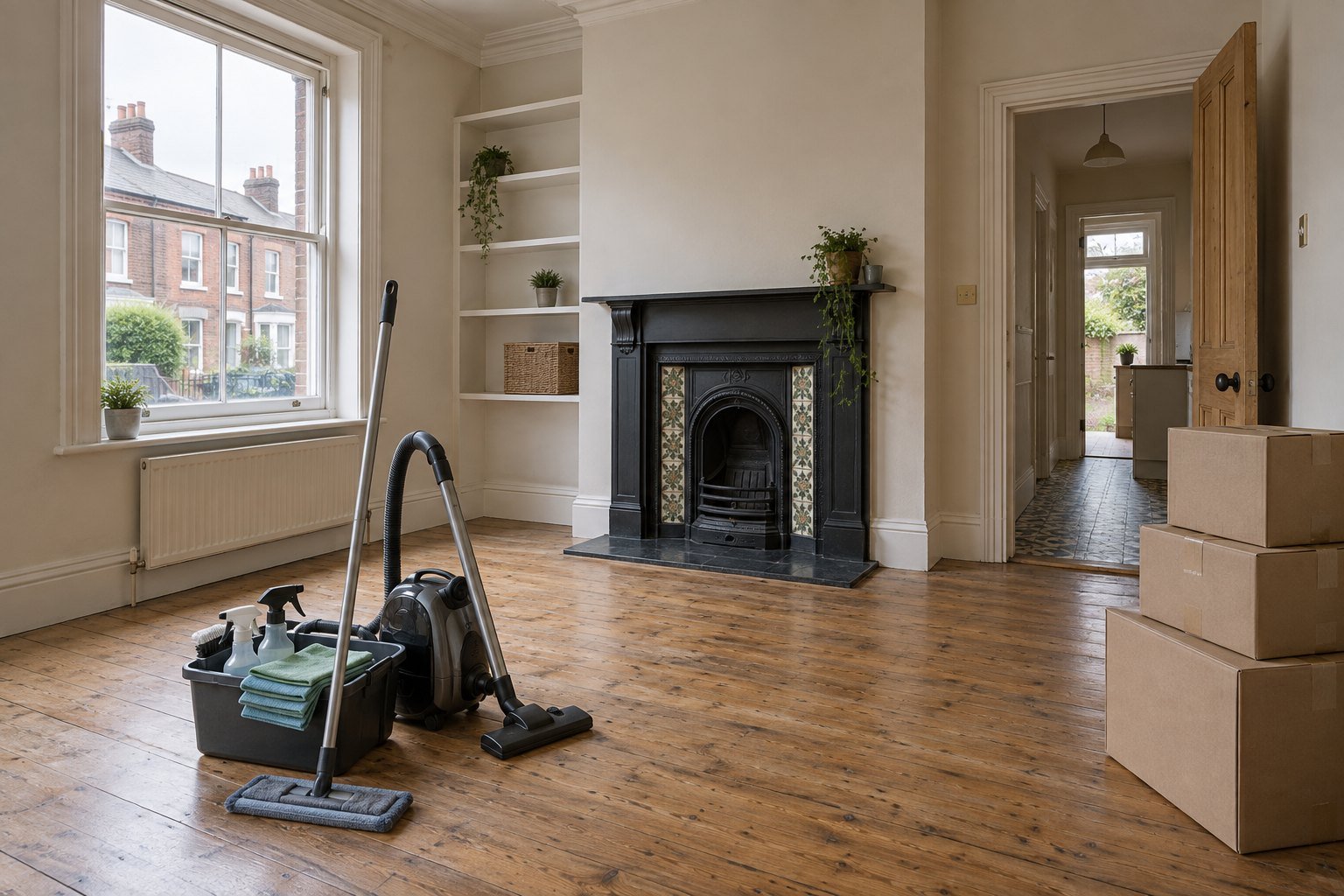
Nobody moves into a new home planning to clean it. You plan to unpack, find the kettle, and sleep. Before furniture arrives, the whole property is easier to reach. Using that window well makes routine cleaning easier after the move.
Why the order of work matters more than the products
Move in cleaning is not really about which spray you buy. It is about sequence. An empty property gives you access to surfaces that become harder to reach once furniture, boxes and appliances arrive. Cleaning in room order can undo work you have already finished, while a planned sequence keeps each step useful.
There are three sequencing principles and everything else follows from them. Clean before furniture arrives wherever the timing allows. Work from the top of a room downwards, so dust and residue fall onto surfaces you have not done yet rather than onto ones you have. And work from the back of the property towards the door, so you are not walking through finished rooms carrying buckets and boxes.
That is the whole method. The rest of this piece is what it looks like applied to a real Manchester property, whether that is a two bedroom flat in Ancoats handed over by an agent, a Victorian terrace in Levenshulme bought from a family who lived there for thirty years, or a new build in Salford where the only soil is builders’ dust.
The empty property window, and how to use it
If you can get keys even a day before the van arrives, take it. An empty property lets you reach skirting, cupboards and floors before furniture and boxes get in the way. If keys and van land on the same morning, the fallback is to clear and clean one room completely, usually the main bedroom, and have everything stacked there while the rest of the house is done.
Before anything else, do a walk round with a notepad and your phone. Photograph the meter readings, photograph anything already damaged or marked, and photograph the general condition of each room. If you are renting, this is your evidence against the inventory and it is worth ten minutes. If you are buying, it is a record of what you inherited. Either way it takes very little time and it can help settle a later disagreement about the condition on handover.
Then do a practical audit while the place is empty. Find the stopcock, the consumer unit, the meters and the loft hatch. Check which windows open and which have been painted shut. Look at where the bins go and find out which day the collection falls on, because a first week with no bin arrangement generates a pile of flattened cardboard that will annoy you for a fortnight. None of that is cleaning, but doing it now rather than later is why the empty window matters.
Working top down, back to front
In each room, start high. Light fittings and shades, the tops of door frames, picture rails in older Manchester housing, curtain poles, the tops of wardrobes if any are built in, and extractor grilles. This material is greasy dust rather than loose dust, so it wants a damp cloth rather than a feather duster, which simply relocates it.
Then work down to the middle band. Walls where marks are visible, light switches and sockets, door handles, radiators including the fins and the wall behind them, window frames, sills and the reveals. In an older property the sash boxes and the channel at the bottom of the window collect years of grit, and that channel is a five minute job when the room is empty and an awkward one once a bed is under the window.
Finish low. Skirting boards, the underside of radiators, then the floor. Clean skirting can change how a whole room reads, and it is also the part that gets harder to finish once furniture is in place.
Back to front means starting at the room furthest from the front door and working towards it. In a terrace that is usually the back bedroom, then the other bedrooms and the bathroom, then downstairs, with the hallway and the front step last. The kitchen is the exception, and it gets its own treatment.
The kitchen, the one room to finish completely on day one
Finish the kitchen before you sleep in the property if you possibly can. It is the room you will use immediately, it is a room with many surfaces that become harder to reach once you fill it.
Inside the cupboards first
Empty cupboards and drawers are a gift. Vacuum out the crumbs and dust, wipe with a mild detergent solution, and let them dry completely with the doors open before anything goes in. Do the same for the shelves and the runners. If a cupboard smells, leave it open for a day rather than masking it, because a closed damp cupboard will transfer that smell to everything you store in it.
The appliances you inherit
Fridges want emptying, shelves out, seals cleaned in the folds where the previous tenant never reached, and the drip channel at the back of the interior cleared. Washing machines want the detergent drawer removed and washed, the door seal wiped out including the underside of the rubber lip, and the filter checked according to the appliance manual. Run a maintenance wash according to the maker’s instructions before the first load of clothes.
Ovens are the job most people abandon. A degreaser needs contact time, so the honest options are a full afternoon with the shelves soaking, or handing it to somebody with a dip tank. Our guide to professional oven cleaning in Manchester sets out what the process actually involves. Whichever route you take, do it while the kitchen is empty, because oven cleaning is messy and you do not want it happening around a full worktop.
The gaps
Pull the freestanding appliances out if they move safely and clean the floor and the wall behind them. The strip of floor beside a fridge or a washing machine is where every previous spill has quietly gone, and once the appliance is back you have effectively sealed it for the length of your tenancy or ownership. Do the same with the gap under the kickboards along the base of the units.
The bathroom, and the parts nobody inherits clean
Bathrooms tend to look acceptable and fail on detail. The parts that matter on a move in clean are the ones a previous occupant cleaned around rather than cleaned.
- The toilet, including under the rim and, more importantly, the outside of the pan and the floor behind it.
- The seat hinges, which unscrew on most modern seats and reveal the least pleasant part of the room. If in doubt, replace the seat entirely, since a new one costs very little.
- Silicone sealant around the bath and shower tray, which either cleans up or tells you it needs replacing before you move your things in.
- The shower head, unscrewed and soaked, because product residue and deposits can restrict the jets.
- The extractor fan grille, taken off and washed, which is easy to overlook in a bathroom.
- The overflow at the back of the basin and bath, which holds a surprising amount and is easily flushed while the room is empty.
Bathrooms are also where a new occupant should establish the ventilation habit on day one. Manchester autumns are wet, and using the extractor fan and airing the room from the first week helps limit persistent moisture and the conditions in which mould can develop.
Floors last in every room, and carpets before the furniture
Floors are always last within a room, because everything you do above them ends up on them. Hard floors want vacuuming thoroughly first, including the edges, then a damp mop with a neutral cleaner rather than a strong one. Old timber and laminate both dislike standing water, so a well wrung mop and two passes beats a wet mop and one.
Carpets are the decision point. If you have inherited carpet you intend to keep, an empty room lets the cleaner reach more of it than a room filled with furniture. It also lets you inspect the sections hidden under the previous furniture, which may differ from the traffic lines.
Two cautions. Give any wet cleaning enough drying time before furniture goes back. Follow the carpet cleaner’s advice on ventilation and temperature for the material and method used. And if the carpet has known pet history, deal with it now rather than hoping, because an existing odour may be harder to address once furniture covers the affected area. Our carpet deep cleaning service is easier to arrange while the room is empty.
The safety pass that belongs in the same walk round
While you are in every room with a cloth, you are also in every room looking at the fabric of the building, so combine the two. Check that smoke alarms sound when you press the test button. If the property has fuel burning appliances, check the carbon monoxide alarm arrangements and raise any uncertainty with the landlord or a qualified professional. Look at the sockets, and be wary of scorching around a socket face, loose fittings or anything that has been extended with a chain of adapters by the previous occupant. Electrical Safety First publishes practical advice on sockets and extension leads that is worth reading before you plug appliances into an unfamiliar property.
Two cleaning specific points sit alongside that. Never spray liquid directly at a socket, a switch or an extractor unit, because the spray goes where you cannot see. And if you inherit an extension lead trailing under a carpet, take it out rather than cleaning around it.
Day two onwards, and what can safely wait
Not everything belongs in the first pass. Some jobs are genuinely better done once you are living in the property and know how you use it.
Windows and glass can wait a fortnight, because the move itself will mark them again. Wardrobe interiors in rooms you have not decided about can wait. Any room you are planning to redecorate should get a functional clean rather than a thorough one, since a deep clean before a decorator arrives is money spent twice. The loft, the cellar and the garden shed are all week three problems, not week one problems, and cellars in older Manchester terraces in particular are better tackled when you have had a chance to see how dry they stay through a wet week.
What should not wait is anything that gets sealed under furniture, anything that smells, and anything to do with the kitchen or bathroom. That is the honest dividing line.
The things people consistently forget
Several easy to miss items belong on the first-week list. The tops of internal doors. The underside of the kitchen wall units, where a previous cook’s grease sits in a thin invisible film. Behind and under the toilet cistern. The letterbox and the inside of the front door. Bin store areas and the wheelie bins themselves, which arrive in whatever state the last household left them. Curtain poles and blind slats where they have been left behind. The immersion cupboard or airing cupboard, which is warm, dusty and about to hold your towels.
Add to that the outside of the property nearest the door. A swept front step and a clean threshold make the entrance feel ready on the first evening.
When it makes sense to book somebody
Plenty of moves need no help at all. Where a professional clean earns its place is when the window is tight, when the property has been empty or neglected, when it has just been refurbished and carries fine builders’ dust, or when you are moving with young children and simply do not have the free hours in the first week.
The other case is the one that surprises people. If you are running an end of tenancy clean at the property you are leaving and a move in clean at the property you are arriving at in the same week, doing both yourself is a genuinely hard weekend. Handing over one of the two is often the difference between arriving settled and arriving exhausted. A full home deep clean is the right specification for a property that has been standing empty, while a lighter targeted visit suits a place that was handed over in decent order.
Getting a price for a move in clean in Manchester
Pricing a move in clean is simple once we know three things. How many bedrooms and bathrooms, whether the property is empty or already part furnished, and whether the oven and any carpets are included. Tell us your key date and your van date and we will tell you which slot actually works, because the value of this job is almost entirely in doing it before your belongings arrive.
We cover the city and the surrounding boroughs, from Salford and Prestwich out to Bury, Bolton, Whitefield and Rochdale. Have a look at what is included in our move in cleaning service, or browse the wider range of residential cleaning in Manchester, then get in touch with your dates and we will build the visit around them.