
What you are actually paying for when the van pulls up
Most householders have no clear idea what a carpet cleaner is going to do to their floor until the kit is already coming through the front door. That uncertainty is fair enough. You are inviting a stranger to put water, heat and chemistry into a soft furnishing you cannot cheaply replace, in a house where a toddler crawls on it and a dog sleeps on it. The questions we get on the doorstep barely change from one job to the next. How wet does it get. How long before we can walk on it in socks. Will the traffic lane come back in a fortnight. What exactly is in that spray.
This is a walk through of a full domestic deep clean, from the first knock to the final look round the room, so you can see what each stage is for and judge whether the job happening in front of you is being done properly rather than rushed. Everything below reflects how our carpet cleaning team in Manchester works in real houses, in terraces, semis and flats where the stairs are narrow and the airing cupboard is already full.
The pre-inspection and fibre test
Nothing gets wet until we have walked the room with you. The first ten minutes are diagnostic, and a technician who skips them is guessing.
Working out what the carpet is made of
Wool, nylon, polypropylene and polyester all behave differently under heat and chemistry. Wool is a protein fibre and dislikes strong alkaline products, so it gets a gentler, closer to neutral approach and lower heat. Polypropylene tolerates aggressive cleaning but attracts oily soil and can wick badly as it dries. Nylon takes cleaning well and responds strongly to stain treatment. We check the fibre, the backing and how the carpet is fitted, because a loose lay over a suspended timber floor in an older property needs a different amount of moisture than a felt backed carpet stuck down on concrete.
Testing before treating
We then test in a hidden spot, usually under a sofa or inside a wardrobe base, to check the dyes are stable and that the product we intend to use does not move colour. We also look for the things that decide realistic expectations, which means pile crush in doorways, shading in front of the sofa, latex breakdown at the seams, and any pre-existing damage such as burns, moth grazing or bleach spots. We tell you at that point which marks we expect to remove fully, which we expect to improve, and which are permanent. Nobody enjoys hearing the last one, but hearing it before the invoice is far better than after.
Preparing the room before any water goes down
Small furniture, dining chairs, coffee tables, floor lamps and toy boxes come out of the room or move to one side. Heavy items such as beds and large wall units usually stay, and we clean up to and around them. Where anything with a wooden or metal foot goes back onto damp carpet, it sits on protective tabs or blocks so wood stain and metal cannot bleed into the pile overnight, which is one of the most common ways a clean gets ruined a day later.
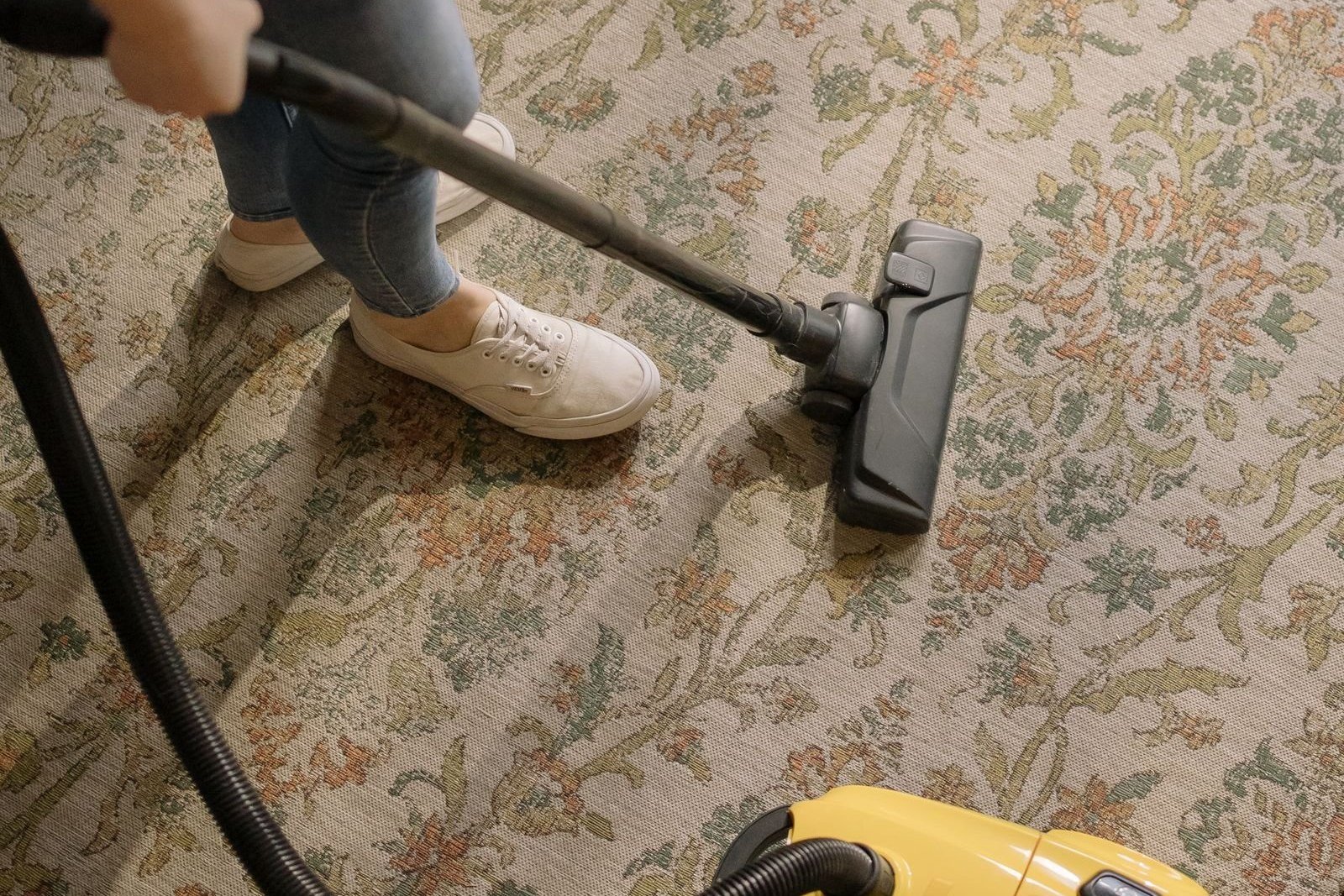
Then comes the dry vacuum, and it matters far more than people expect. A large share of what sits in a carpet is dry particulate, which in Manchester means street grit, brick dust from ongoing building work, and whatever the school run brings back in. Wet that soil before you lift it and you turn it into mud that is bonded to the fibre. We vacuum slowly and in more than one direction, giving real attention to edges, the bottom stair riser and the strip immediately inside the front door.
Pre-spray, dwell time and why the product choice matters
Deep cleaning is chemistry plus time plus agitation, and only then water. We apply a pre-spray suited to the fibre and the soil type, a degreasing product where there is body oil and food traffic, something milder and closer to neutral for wool. It is then left to dwell, usually for several minutes, because the product needs contact time to break the bond between the soil and the fibre. A technician who sprays and immediately extracts has cut the only free step in the process and the carpet will show it within weeks.
Product choice is also where household safety is decided, and it is worth knowing what to ask. Professional cleaning chemicals are diluted, applied to a surface and then rinsed away rather than left as a wet film, and that rinse is the main control. Beyond that, the useful question is whether your cleaner can tell you what they are actually using. We buy from suppliers working to recognised trade standards, including members of the Cleaning and Hygiene Suppliers Association, whose accreditation schemes are independently audited so that what is on the box is genuinely what is in the box and the product meets the specification it claims. That traceability is the practical difference between a documented, dilutable professional product and an unlabelled drum, and it is what lets us answer honestly when a parent asks what has just gone onto the floor their baby plays on.
We also keep the room ventilated during and after treatment, and we ask that pets are kept in another room until the carpet is dry and the airflow has done its work.
Agitation, the step that gets quietly skipped
Once the pre-spray has dwelled, it needs working into the pile. On most cut pile carpets we use a groomer or a counter rotating brush, which lifts matted fibre, distributes the product evenly to the base of the pile rather than leaving it sitting on the tips, and gives the chemistry the mechanical help it needs. On heavily soiled traffic lanes, hallways and stairs, this is often done twice.
Agitation is the honest dividing line between a surface refresh and a genuine carpet deep clean. A machine passed over an untreated, unagitated carpet will pull out water and a little soil and leave the carpet looking briefly better. It will not shift the bonded, greasy soil at the base of the pile, which is exactly the soil that makes a carpet look grey and tired six months into its life.
The hot water extraction pass
Hot water extraction is the main event and the method most carpet manufacturers expect for a deep clean. Heated water, usually with a rinse agent, is injected into the pile under pressure and recovered in the same movement by a powerful vacuum, taking the loosened soil and the spent pre-spray with it. Done with a portable machine, the waste goes to a tank in the van or a recovery tank in the property. Done with a truck mounted unit, the heat and vacuum come from the vehicle and only hoses come through the door, which is why we run a hose down the hallway and ask that the front door stays on the latch.
Technique is what separates a good extraction from a soaking. Passes overlap, and each wet pass is followed by one or more dry passes with no water going down, purely to recover moisture. The wand is kept moving at a steady speed, because dwelling in one spot pushes water into the backing and underlay where the machine cannot retrieve it. On stairs we work top down with a hand tool, treating each riser and tread separately. Around the perimeter we work carefully so that water does not run under the gripper rods and into the skirting.
Correctly executed, the carpet comes up damp rather than wet. If you can press a palm into the pile afterwards and lift standing water, too much has gone in and not enough has come back out.
Stain specific treatment and what can realistically be shifted
Most of what looks like a stain is simply soil, and it goes with the main clean. What is left after extraction gets individual attention, because a single spot treatment applied to a whole room is both wasteful and unnecessary.
The marks we treat separately
Tannin marks from tea, coffee and red wine take an acidic treatment. Protein deposits from milk, food and pet accidents take an enzyme based product with dwell time. Oil, grease and cosmetic marks take a solvent. Pet urine is the one that needs the most honesty, because the visible mark, the odour and the dye damage are three separate problems. Urine that has soaked through to the underlay usually needs a targeted flush and a specific odour treatment, and if the salts have already altered the carpet dye, cleaning will remove the smell and the residue but cannot put the colour back.
Some things genuinely cannot be reversed. Strong artificial dyes from squash and some inks, bleach and household cleaner splashes, and sun bleaching along a bay window are all colour loss rather than added soil. In those cases we say so at the inspection stage rather than promising an outcome we cannot deliver.
Wicking is the other one worth understanding. A spill that reached the backing can travel back up the fibre as the carpet dries, so a mark that looked gone on the day can reappear faintly the next morning. It is normal, it is fixable, and any competent cleaner will come back and re-treat it.
Drying times and how to speed them up
With a well executed extraction, most carpets are dry to the touch in roughly two to six hours and fully dry within a day. The range depends on pile depth and density, how soiled the carpet was, the airflow in the room and the weather outside, which in a Manchester November is not a small factor. A dense wool twist in a cold back room will always take longer than a low pile bedroom carpet in July.
What actually helps, in order of usefulness, is air movement first. We leave air movers running where the job calls for it, and you can keep the effect going with a domestic fan pointed across the pile rather than down into it. Second is ventilation, so open windows a little on both sides of the property to get a cross draught, unless it is pouring outside. Third is gentle background heat rather than a blast, since warm damp air needs somewhere to go or it simply condenses on the windows. Running a dehumidifier in a closed room is highly effective in damp weather.
Meanwhile, keep off the carpet where you can, and if you must cross it, use clean socks or the shoe covers we leave rather than bare feet or outdoor shoes. Keep the furniture on its protective tabs until the pile is properly dry, and leave the vacuuming for at least twenty four hours.
The final walk round and what happens next
Before we pack down, we groom the pile so it dries lying in one direction, which is why a freshly cleaned carpet looks uniform rather than swirled. We then walk the room with you in daylight, point out anything that has been improved rather than removed, flag anything we expect might wick, and explain what to do if it does. If a protector has been applied, we explain what it does and does not do, which is buy you time to blot a spill, not make the carpet immune to one.
After that, the result lasts as long as your maintenance lets it. Regular vacuuming, prompt blotting rather than rubbing, and a decent barrier mat at the front door do most of the work. How long you should leave it before the next professional visit depends on the household, and we cover that separately in our guide to how often carpets should be cleaned.
If your carpets have reached the stage where vacuuming no longer changes how they look, a full deep clean is the reset. We work across Manchester and the surrounding areas, in occupied family homes, rented properties and end of tenancy handovers, and we are happy to talk through what your specific carpets need before you commit. Take a look at our Manchester carpet cleaning services or get in touch for a straight assessment of what can and cannot be achieved on your floors.